

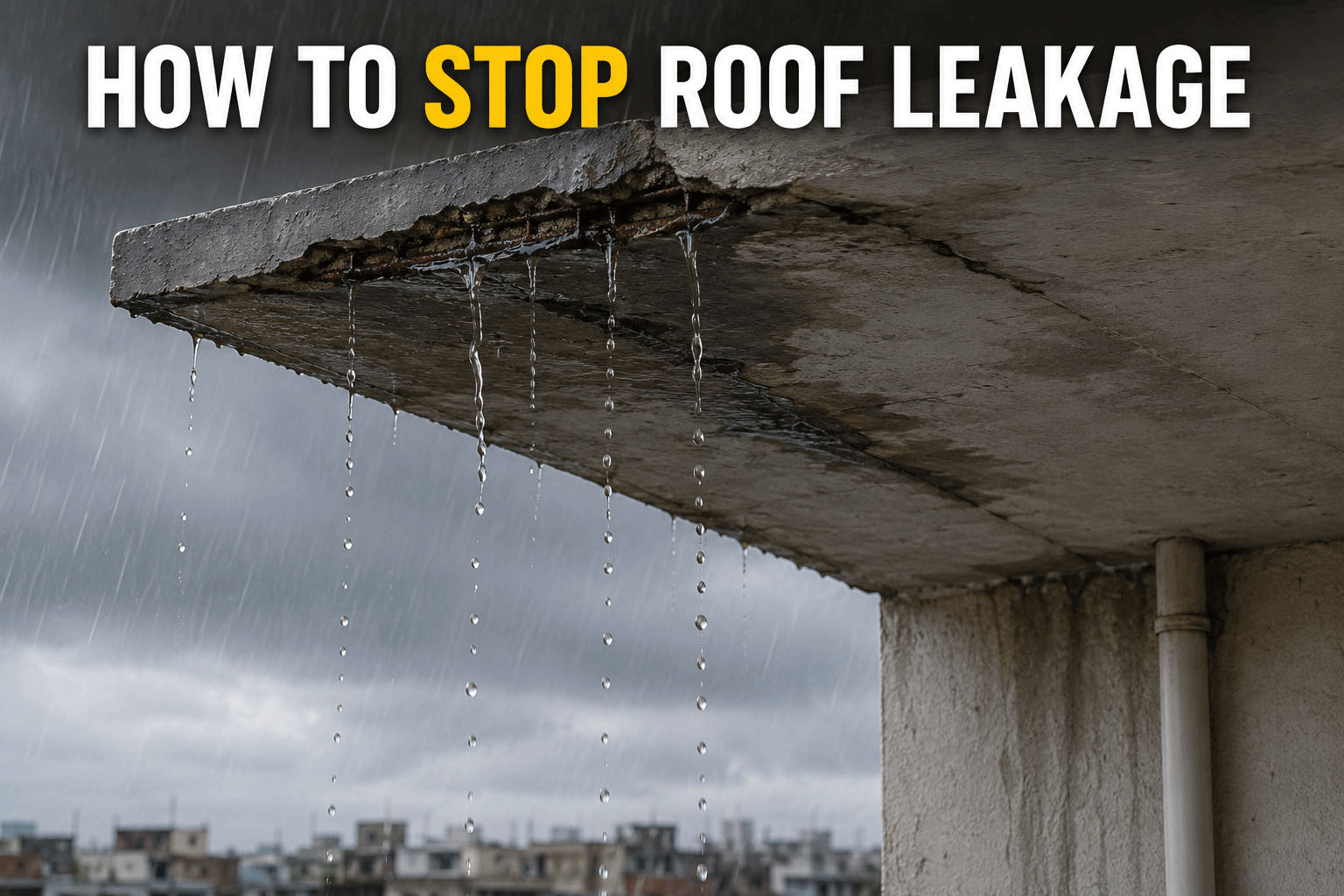
If your roof is actively leaking right now: Call Bhawani Technologies at +91-9555808158. We provide emergency roof leakage repair across Delhi NCR. Read this guide while waiting - it tells you exactly what to do in the next 30 minutes to limit damage.
Delhi Monsoon 2026 and the Roof Leakage Crisis
Delhi NCR receives over 600mm of rainfall between July and August, with intense spells hitting 30–50mm per hour during peak monsoon weeks. Across the city right now, thousands of homeowners are discovering that their terraces, roofs, and slabs - which looked fine all year - are leaking the moment the first serious rain arrives.
This is not a coincidence. Roofs that survived previous monsoons on deteriorating waterproofing finally give way as the system degrades one season too far. Hairline cracks that were invisible in March become active leak points in July. And construction defects that were masked by dry conditions suddenly reveal themselves in the first week of rain.
This guide answers the questions that homeowners across Delhi, Noida, Gurgaon and Ghaziabad are searching for right now - specifically during the monsoon when the problem is already happening:
- What to do if your roof is leaking this very moment
- Can any meaningful repairs be done during the monsoon?
- Which temporary fixes actually work (and which waste your money)
- How to identify whether the damage is minor or structural
- What permanent repair options are available and when to schedule them
What to Do Right Now If Your Roof Is Leaking (Next 30 Minutes)
Act in this order. Speed matters - water damages flooring, walls, electrics and furniture fast.
- Move everything out of the wet zone immediately. Electronics, documents, furniture, appliances. Electrical short circuits from roof leakage are a serious safety risk - if water is near a light fitting, switch off the MCB for that circuit at your distribution board.
- Place large buckets or containers under active drip points. Lay plastic sheets or tarpaulin over flooring to protect wood, tiles and carpets. Use old towels along wall edges to stop water spreading.
- Document everything with photos and video before touching anything. This matters for insurance claims and for showing your contractor the exact leak pattern - which helps them identify the entry point faster.
- Do NOT go on the wet terrace or roof. Wet RCC slab surfaces, especially with algae growth, are extremely slippery. Every year, people are injured attempting to seal leaks themselves during rain. Leave the roof alone until a professional arrives.
- Call a professional waterproofing contractor immediately. Emergency temporary sealing - not full waterproofing - can be done even during rain in most cases. This buys time until a permanent repair can be scheduled in dry conditions.
- Check adjacent rooms and the floor below. A leak visible in one room often has water travelling through the slab from an entry point several feet away. Mark all affected areas before the professional visits.
Can Waterproofing Be Done During Monsoon in Delhi?
This is the question every Delhi homeowner asks in July, and the honest answer is: it depends on what you need done.
What CAN Be Done During Monsoon Rain
- Emergency crack injection grouting: Polyurethane or epoxy injection into active cracks can be done even while water is flowing - the material reacts with moisture and expands to seal the crack. This is the most effective emergency intervention.
- Crystalline waterproofing on damp surfaces: Crystalline compounds work by reacting with moisture in concrete to form insoluble crystals that block water paths. They can be applied on a damp surface - making them one of the few systems usable during monsoon.
- Hydraulic cement for active leaks: A fast-setting hydraulic cement can stop active water flow through a crack or joint within minutes. This is a temporary stop - not a permanent waterproofing solution - but it halts immediate damage while permanent repair is scheduled.
- Interior ceiling treatment: Anti-damp coatings on interior ceiling surfaces (below the slab) reduce moisture migration and staining while permanent exterior repair is arranged.
What CANNOT Be Done During Active Rain
- APP/SBS bituminous membrane application: These require a completely dry substrate - moisture under the membrane causes blistering, adhesion failure and premature delamination. Cannot be applied during rain or on a wet surface.
- PU liquid waterproofing (full coat): Requires dry conditions for proper adhesion and curing. Rain during or shortly after application ruins the system.
- Polymer/cementitious screed coatings: Need dry application conditions and 24–48 hours of dry curing before any rain contact.
- EPDM or other sheet membranes: Require dry substrate and dry conditions for adhesive or heat-weld joints.
The practical strategy: Use emergency crack injection and crystalline treatment NOW to stop active damage. Then schedule membrane waterproofing for a dry weather window - these windows do occur between monsoon spells in Delhi, typically lasting 3–7 days. A professional contractor monitors weather forecasts and schedules accordingly. Do not wait until post-monsoon if the structure is being damaged.
Why Delhi Roofs Leak During Monsoon - The Real Causes
Understanding why the leak is happening helps you explain it to your contractor and understand what repair is actually needed. Roof leakage in Delhi during monsoon has six primary causes:
1. Failed or Aged Waterproofing System
Most Delhi terraces have a waterproofing lifespan of 5–15 years depending on the system. If your terrace was last waterproofed more than 7–8 years ago, the material has degraded through UV exposure, thermal cycling (45°C summer to 5°C winter) and physical wear. The monsoon simply exposes what the rest of the year hid.
2. Hairline Cracks in the RCC Slab
RCC slabs in Delhi expand and contract significantly with temperature change - up to 10–12°C daily variation in summer. Over years, this creates micro-cracks at stress points: slab edges, column-beam junctions, construction joints, and around pipe penetrations. These cracks are often invisible during inspection in March but act as water channels during July downpours.
3. Clogged or Poor Drainage
If terrace drains are blocked with debris (leaves, dust, pigeon nests), water ponds on the terrace surface and the hydrostatic pressure eventually forces it through minor cracks that would otherwise not leak. A 500 sq ft terrace with 25mm of ponded water holds over 1,200 kg of water - significant pressure on the slab below.
4. Parapet Wall Junction Failure
The joint between the terrace slab and the parapet wall is the most common single failure point in Delhi roofs. This junction is subject to differential movement between the wall and slab, and waterproofing that does not adequately address this joint will fail here first. Water enters through the wall-slab junction, travels through the slab, and appears as a stain or drip on the ceiling below - sometimes 2–3 feet from where it actually entered.
5. Bathroom or Water Tank Above
If the room that is leaking is directly below a bathroom, kitchen or water tank on the floor above, the leak source may not be the roof at all - it may be a bathroom slab or water tank base failure. This is critical to identify correctly before spending money on roof waterproofing. A professional inspection should distinguish between terrace leakage and bathroom/tank leakage.
6. Construction Defect in New Buildings
In newly constructed buildings (less than 5 years old), monsoon leakage is typically due to construction defects - inadequate concrete cover over rebar, poor-quality concrete, missing waterproofing in construction joints, or inadequate curing. This is a builder defect. Document it carefully - many Delhi apartments have builder warranty provisions for structural defects.
How to Identify Whether Your Roof Leak Is Minor or Structural
Not all monsoon roof leaks are equal. Some are surface waterproofing failures that are straightforward to repair. Others indicate structural concrete deterioration that needs urgent attention. Here is how to tell the difference:
| Sign | What It Likely Indicates | Urgency |
|---|---|---|
| Ceiling damp patch or stain, no dripping | Water absorbed in plaster - waterproofing failure | High - repair before next rain |
| Active drip from ceiling during rain | Crack in slab or failed waterproofing - water found a direct path | Very high - emergency repair |
| Ceiling plaster bulging or peeling | Repeated water saturation - ongoing structural wetting | Very high - structural risk building |
| Rust-coloured stains on ceiling | Rebar corrosion - steel reinforcement getting wet, actively rusting | Critical - structural damage in progress |
| Concrete spalling (chunks falling) on ceiling | Advanced rebar corrosion - concrete cracking from rust expansion | Emergency - structural safety risk |
| Wall seepage or damp patches on interior walls | Parapet wall or external wall leakage - water entry through walls | High - worsens each monsoon |
Important: Rust stains or concrete spalling on your ceiling are not cosmetic problems. They mean the structural steel inside your slab is corroding. This is progressive and accelerates every monsoon. Do not paint over it - have it professionally assessed immediately.
Temporary Fixes That Actually Help (and Those That Don't)
While waiting for a professional, some temporary measures genuinely help. Others are commonly attempted but waste money and time.
Temporary Measures That Help
- Hydraulic cement on visible cracks: If you can safely access the terrace and identify a visible crack, a quick application of hydraulic stop-leak cement from any hardware store can slow or stop active water flow through that specific crack. It is not a permanent solution but buys time.
- Drainage clearance: If terrace drains are blocked, safely clearing them (from the terrace - not from scaffolding in rain) reduces ponding and therefore reduces pressure on the slab. This can immediately reduce the severity of leakage.
- Interior protection: Tarpaulin, plastic sheets and buckets are obvious but genuinely limit water spread and protect finishes and furniture from secondary damage while permanent repair is arranged.
Temporary Fixes That Are a Waste of Money
- Bitumen paint brushed over a wet surface: Will not adhere to a wet substrate and will peel off in the first rain. Zero waterproofing value. Very commonly offered by local painters during monsoon - avoid.
- White cement patching over a damp area: Surface-level patching without proper crack preparation and injection will crack again in the next thermal cycle and will not stop sub-surface water movement.
- Polymer paint applied in rain: Cannot cure properly and will fail almost immediately. Money wasted.
- "Waterproof" epoxy paint on ceiling: Addressing the symptom (interior surface) rather than the source. Water continues entering the slab and damaging the structure even if the ceiling looks dry temporarily.
Permanent Roof Leakage Repair in Delhi - Planning Your Post-Emergency Fix
Emergency stabilisation during monsoon buys time. But the permanent solution needs to be planned now so work can begin in the first available dry weather window. Here is what permanent roof leakage repair in Delhi involves:
Step 1 - Professional Diagnosis
A proper inspection using moisture meters maps where water is entering the slab, not just where it is appearing on the ceiling. These two points are frequently different. Entry point identification is essential before any repair work is scoped.
Step 2 - Surface Preparation
Existing failed waterproofing, loose screed and damaged concrete are removed. Cracks are cut open, widened slightly (V-cutting or U-cutting) and primed before filling - not simply painted over. This step determines whether the repair lasts 2 years or 12 years.
Step 3 - Crack Injection
Active cracks and hairline cracks are filled with polyurethane or epoxy injection under pressure to ensure the full depth of the crack is sealed - not just the surface. This is the step most cheap contractors skip.
Step 4 - Waterproofing System Application
Depending on the diagnosis, the appropriate system is applied: APP bituminous membrane for most flat terraces, PU liquid waterproofing for complex surfaces, or crystalline treatment for specific moisture migration issues. See our full guide on terrace waterproofing in Delhi for system details.
Step 5 - Parapet and Junction Treatment
The wall-slab junction, parapet cap and all pipe/duct penetrations receive a reinforced treatment - this is the most failure-prone zone and must be addressed in every repair scope.
Step 6 - Protection and Warranty
A screed or tile protection layer is applied over the membrane where needed. All work is documented with a written warranty specifying the system used, the date applied and the warranty period.
Cost of Emergency Roof Leakage Repair in Delhi During Monsoon 2026
Costs depend on whether you need emergency temporary stabilisation only, or whether a dry weather window allows partial or full permanent repair during the monsoon period.
| Repair Type | When Applicable | Estimated Cost (Delhi NCR) |
|---|---|---|
| Emergency crack injection (per metre) | During rain - immediate | ₹1,200 – ₹2,500 / running metre |
| Hydraulic stop-leak + temporary seal (small area) | During rain - immediate | ₹3,000 – ₹8,000 lump sum |
| Crystalline waterproofing (interior slab treatment) | During monsoon, on damp surface | ₹80 – ₹150 / sq ft |
| Full terrace waterproofing - APP membrane | Dry weather window (3+ dry days) | ₹60 – ₹90 / sq ft |
| Full terrace waterproofing - PU liquid | Dry weather window (3+ dry days) | ₹70 – ₹100 / sq ft |
| Parapet wall waterproofing (per running metre) | Dry weather window | ₹350 – ₹700 / running metre |
For basement waterproofing in Delhi and bathroom waterproofing in Delhi during monsoon, similar emergency-then-permanent strategies apply - some systems are usable on damp substrates while membrane systems require dry windows.
Note: All costs above exclude structural repair (spalling concrete, rebar treatment) which is assessed and quoted separately after inspection. We always provide a free inspection and written itemised quotation. You know the full cost before any work begins.
Delhi NCR Neighbourhoods Most Affected by Monsoon Roof Leakage in 2026
Certain areas of Delhi NCR are disproportionately affected by roof leakage during monsoon due to older building stock, soil conditions or drainage infrastructure. If you live in one of these areas and have not addressed your roof waterproofing, the 2026 monsoon is a high-risk period:
- Old Delhi, Lajpat Nagar, Shahjahanabad: Older construction from the 1970s–1990s with original or poorly maintained waterproofing. Many buildings have had multiple layers of paint or cheap polymer applied over failing systems.
- Dwarka Sectors 1–23: Rapid construction from the early 2000s. Many buildings now 20+ years old with waterproofing systems reaching end of life simultaneously. High DDA flat density means multi-floor leakage disputes are common.
- Noida Sectors 18–62: Mix of builder flats and independent houses. Builder waterproofing quality was inconsistent; many 10–15 year old buildings are seeing waterproofing failures this monsoon.
- Gurgaon - Old Gurgaon (Sectors 1–14): Older construction and inadequate municipal drainage means roof and basement flooding is common in heavy rain spells.
- Ghaziabad - Vaishali, Indirapuram, Kaushambi: High water table in some sectors combined with aging building stock creates both roof and basement leakage risk during peak monsoon.
- Greater Noida - Sector Knowledge Park, Omega: Newer construction but some early builders used low-grade waterproofing materials that are now failing at the 8–12 year mark.
How Bhawani Technologies Handles Monsoon Roof Leakage Emergencies
During Delhi's monsoon season, we operate an emergency response system for roof leakage across Delhi NCR. Here is exactly what happens when you call us:
- Same-day or next-day inspection: Our engineer visits your property, assesses the leak source, maps moisture with a meter, and identifies entry points vs. appearance points.
- Emergency stabilisation (if active leak): If the building is being actively damaged, we perform immediate crack injection grouting or temporary hydraulic sealing - regardless of weather - to stop ongoing structural wetting.
- Written report and quotation: You receive a written inspection report and itemised quotation for both emergency work and the permanent repair. No verbal commitments, no hidden surprises.
- Permanent repair scheduling: We monitor weather forecasts for a suitable dry window (typically 3–7 consecutive dry days). When the window arrives, we mobilise immediately for permanent membrane or PU waterproofing.
- Written warranty on permanent work: Every permanent repair carries a written service warranty. The warranty document specifies the system, date applied, and warranty period.
We cover all of Delhi NCR - Delhi, Noida, Greater Noida, Gurgaon, Ghaziabad, Faridabad and surrounding areas - with the same free inspection, transparent pricing and written warranty commitment on every project.
For full details on our waterproofing services, visit our terrace waterproofing Delhi, roof leakage repair Delhi and waterproofing services pages.
Frequently Asked Questions
-
Can waterproofing be done during monsoon in Delhi?Yes - certain systems can be applied during the monsoon. Crystalline waterproofing and injection grouting work on damp surfaces and can be done even in rain. Full membrane systems (APP, EPDM, PU) require 3–5 consecutive dry days - windows that do occur between monsoon rain spells in Delhi. Emergency temporary sealing can be done immediately regardless of weather to stop active structural wetting.
-
What should I do if my roof is leaking right now during monsoon?Immediately: move valuables and electronics away from the wet zone, switch off MCB if water is near electrical fittings, place buckets under drip points, photograph everything, and do NOT go on the wet roof. Call a waterproofing professional - emergency temporary sealing can usually be done within 24–48 hours even during rain. Call Bhawani Technologies at +91-9555808158 for emergency service across Delhi NCR.
-
Why does my roof only leak during heavy rain but not light rain?This is a classic sign of a crack or joint failure that gets overwhelmed during intense downpours. Delhi's July–August monsoon can deliver 30–50mm per hour, creating hydrostatic pressure that forces water through defects that lighter rain would not expose. This problem worsens each monsoon season and should be repaired - not monitored.
-
How long can I wait before getting roof leakage repaired?Do not wait. Every monsoon cycle through an untreated crack drives water deeper into the slab, corroding the internal rebar. Rust expands and causes spalling - a progressive structural failure. Emergency temporary sealing stops active damage; permanent repair should be scheduled for the first available dry weather window, not deferred until post-monsoon.
-
What is the cost of emergency roof leakage repair in Delhi during monsoon?Emergency crack injection grouting costs ₹1,200–₹2,500 per running metre. Temporary stop-leak sealing for a small area costs ₹3,000–₹8,000 as a lump sum. Full permanent waterproofing (₹60–₹100/sq ft) is scheduled for the next available dry weather window. We provide a free inspection and written itemised quotation before any work begins.
-
My ceiling has rust-coloured stains - is that serious?Yes - this is serious. Rust stains on your ceiling mean the steel reinforcement inside the slab is getting wet and actively corroding. Rusting rebar expands and causes the surrounding concrete to crack and spall. This is structural deterioration, not a cosmetic problem. Do not paint over it. Get a professional assessment urgently - the longer it continues, the more expensive the repair becomes.
The Bottom Line: Act Now, Not After the Monsoon
The instinct to wait until the monsoon ends before dealing with a leaking roof is understandable. But it is costly. Every rain spell that passes through an unrepaired crack does cumulative structural damage - to the concrete, to the rebar, to the plaster, and to the structure's long-term integrity.
Emergency stabilisation during the monsoon is entirely possible. Permanent repair can be scheduled for dry windows between rain spells. And when the monsoon ends, a fully scoped repair can be completed before the next one arrives.
The most expensive roof leak is the one that gets ignored for one more season.
Once the rain actually stops, don't stop there — see our Post-Monsoon Waterproofing Checklist 2026 for the full inspection list and repair window before winter arrives.
Contact Bhawani Technologies for free emergency inspection and assessment across Delhi NCR. We cover roof leakage repair, terrace waterproofing, basement waterproofing and bathroom waterproofing - call us at +91-9555808158.