

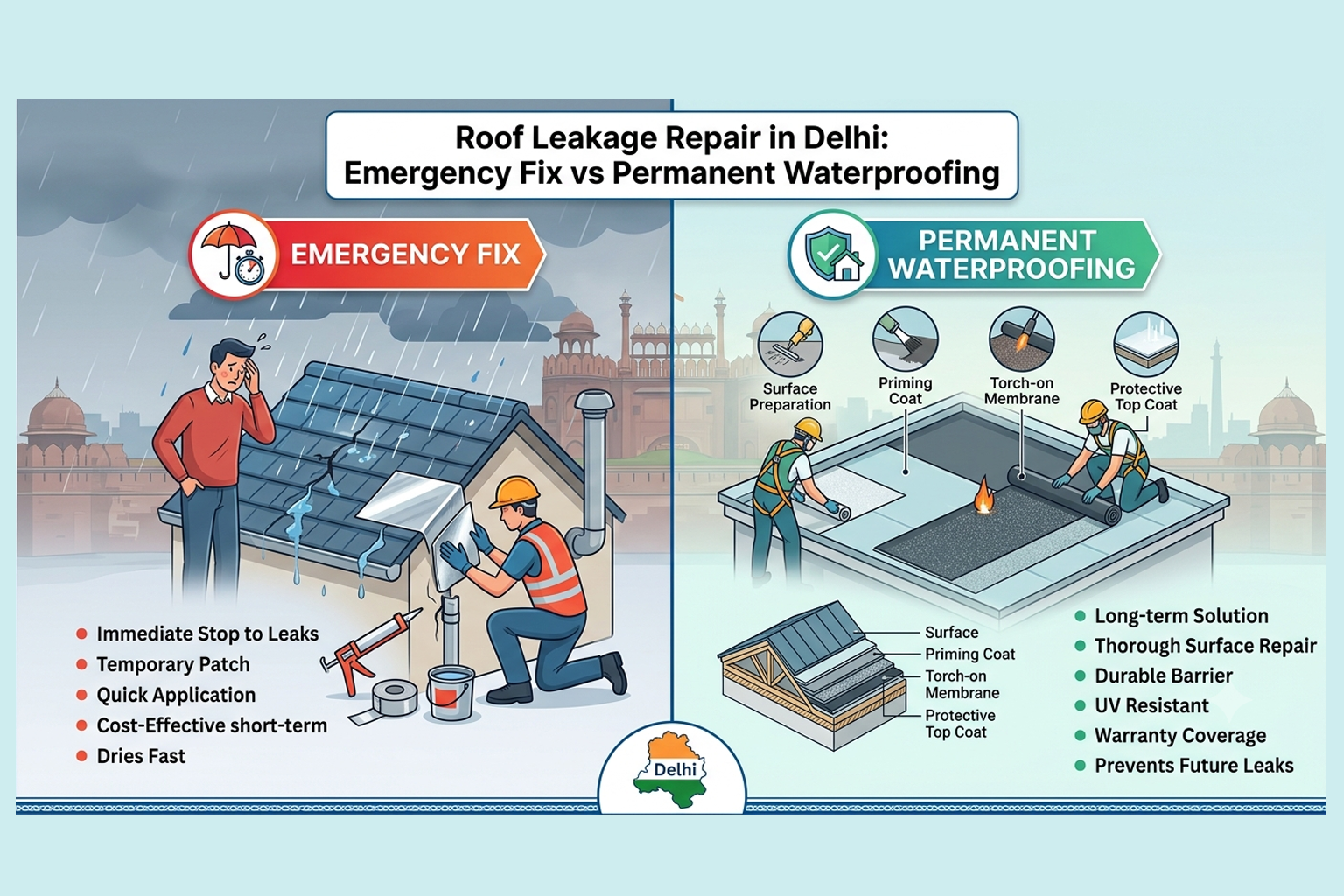
The trap most homeowners fall into: they buy a tube of sealant from the hardware store, plug the drip, and mentally file the problem as "fixed." It isn't. A sealant is a pause button, not roof leakage repair. This guide breaks down the two real options in Delhi — emergency bandage fixes vs permanent waterproofing — so you choose correctly before the next heavy spell exposes the same leak again.
Roof Leakage Repair in Delhi: Two Categories, Often Confused
Almost every option for roof leakage repair in Delhi falls into one of two fundamentally different categories. Understanding the difference is the entire decision:
- Emergency / bandage fixes: Silicone sealant, bitumen paint, hydraulic cement, waterproof flashing tape, spray sealants. These block the specific point water is currently exiting through. They do nothing to address why water entered the concrete in the first place.
- Permanent waterproofing systems: APP bituminous membrane, PU liquid waterproofing, crystalline treatment, polymer-modified cementitious coatings. These are engineered systems, applied after proper surface preparation and crack injection, designed to stop water entry entirely for 7-15+ years.
The confusion happens because both categories stop the drip you can see. Only one of them stops the water actually entering your slab.
Side-by-Side: Bandage Fix vs Permanent System
| Factor | Emergency Bandage Fix | Permanent Waterproofing |
|---|---|---|
| What it actually does | Blocks the visible exit point only | Stops water entering the structure entirely |
| Typical lifespan | A few weeks to one monsoon season | 7-15+ years depending on system |
| Can be applied during rain? | Yes, most types | No — needs 3-5 consecutive dry days to cure |
| Cost (one application) | ₹500 - ₹8,000 | ₹35 - ₹150 per sq ft (full area) |
| Cost over 10 years | Often higher — repeated every season plus hidden structural damage | Lower — one application, written warranty |
| Stops rebar corrosion? | No — water still reaches the slab between applications | Yes — this is the entire purpose of the system |
| Comes with a warranty? | Rarely, if ever | Yes, from a professional contractor |
How to Stop Roof Leakage in Monsoon Right Now — The Decision Framework
Work through these questions in order. Where you stop tells you what to do next.
- Is water actively entering right now, during rain? If yes, an emergency fix (hydraulic cement or crack injection) is the correct first move — regardless of what you do afterward. Stop the immediate damage first.
- Has this exact spot leaked before? If this is a repeat leak — even if someone "fixed" it last year — a bandage fix is not the answer this time. Repeat leakage at the same point means the underlying waterproofing has already failed and needs full replacement, not another patch.
- Is monsoon still active, or has it ended? If monsoon is ongoing, apply an emergency fix now and schedule permanent waterproofing for the next dry window. If monsoon has ended, skip the bandage stage entirely and go straight to permanent repair — you have the weather for it.
- Is the affected area small and isolated, or larger/recurring across the roof? A single small crack may be addressed with targeted injection as part of a permanent fix. Multiple leak points or a large affected area indicate the whole waterproofing layer has aged out and needs full re-application, not spot treatment.
- Do you see rust stains or concrete spalling? This is not a bandage-fix situation under any circumstance. It means reinforcement steel is already corroding. Get a professional structural-aware inspection before any surface fix is applied.
Emergency Bandage Fixes: What Each One Actually Does
| Product | Best Use Case | Realistic Lifespan |
|---|---|---|
| Hydraulic cement | Actively flowing water through a crack, applied during rain | Hours to weeks — stops flow, doesn't waterproof |
| Silicone sealant | Small gaps around pipe penetrations, dry surface only | One season, if applied on a properly dry, clean surface |
| Bitumen paint | General surface coating on a dry terrace | One season — peels rapidly if applied wet |
| Waterproof flashing tape | Parapet joints, flat seams, quick coverage | A few weeks to a season, UV degrades adhesive fast |
| Emergency crack injection (PU/epoxy) | Active structural cracks, works even in rain | Can be semi-permanent for the specific crack, but doesn't waterproof the surrounding area |
Important: None of these products are designed to survive Delhi's full annual cycle — 45°C+ summer surface temperatures, winter cold, and UV exposure — the way a proper membrane or PU system is. Treat every item on this list as a holding measure, not repair.
Permanent Waterproofing Systems: The Real Roof Leakage Repair
| System | Best Use Case | Cost & Lifespan |
|---|---|---|
| APP bituminous membrane | Most flat terraces and roofs | ₹60-90/sq ft — 10-15 years |
| PU liquid waterproofing | Complex shapes, multiple pipe penetrations | ₹70-100/sq ft — 8-12 years |
| Crystalline waterproofing | Basements, damp substrates, can apply on damp surface | ₹80-150/sq ft — 15-25 years |
| Polymer cementitious coating | Bathrooms, smaller areas, budget-conscious projects | ₹35-55/sq ft — 5-8 years |
Every permanent system starts with the same non-negotiable steps: professional moisture-meter diagnosis, removal of failed material, crack injection under pressure, then system application per manufacturer specification — not a quick coat over the existing problem. See our detailed roof leakage repair in Delhi and terrace waterproofing guides for the full process.
The Hidden Cost of Staying in "Bandage Mode" Forever
The maths that convinces most homeowners to keep buying sealant every year is incomplete. It only counts the price of the tube — not what's happening underneath while you're not looking.
What repeated bandaging actually costs: Reapplying sealant or bitumen paint every season for 8-10 years typically adds up to more in cumulative material and labour than one permanent system — and that's before counting the damage. Between each application, water that finds even a hairline gap keeps reaching the slab and corroding the steel reinforcement inside it. That corrosion is invisible until it becomes concrete spalling, at which point the repair is no longer a waterproofing job — it's a structural one, costing several times more.
A permanent system costs more on day one. It becomes the cheaper option somewhere around year 3-4, and stays cheaper for every year after that — while also being the only option that actually stops the underlying damage.
5 Signs You Need Permanent Roof Leakage Repair, Not Another Bandage
- The same spot has leaked more than once, even after a previous "fix"
- You see rust-coloured stains or any concrete flaking on the ceiling
- The affected area has grown larger over successive monsoons
- A sealant or coating applied last season has already failed
- The leak is accompanied by a persistent musty smell or visible mould
If any of these apply to your property, book a professional inspection before applying another temporary product — you'll likely be spending money that doesn't solve the actual problem.
How Bhawani Technologies Handles Both Stages
We offer waterproofing services in Delhi that cover both sides of this decision under one roof — not two separate vendors giving conflicting advice:
- Free inspection first: A moisture-meter assessment tells us — and you — whether this is a bandage situation, a permanent-repair situation, or both in sequence.
- Emergency stabilisation if needed: If water is actively entering, we apply crack injection or hydraulic sealing immediately, regardless of weather, to stop ongoing structural damage.
- Written, itemised quotation: You get a clear scope for the emergency work and, separately, for the permanent system — no bundling, no guesswork.
- Permanent system scheduled for a dry window: We track weather forecasts and mobilise for full roof leakage repair the moment a suitable dry spell arrives.
- Written warranty on the permanent work: Every completed system comes with a documented warranty — something no bandage fix will ever offer you.
We provide waterproofing services in Delhi, Noida, Gurgaon, Ghaziabad and Faridabad — call +91-9555808158 for a free inspection, or see our full emergency response guide if your roof is leaking right now.
Frequently Asked Questions
-
What does roof leakage repair in Delhi actually involve — sealant or permanent waterproofing?Proper roof leakage repair in Delhi involves two possible stages: an emergency bandage fix (sealant, hydraulic cement, tape) that blocks the visible exit point, and permanent waterproofing (membrane, PU, crystalline) that stops water entering the structure entirely. A sealant alone is not repair - it is a temporary hold until the permanent system can be applied.
-
How to stop roof leakage in monsoon right now, before permanent repair is possible?Use hydraulic cement or PU/epoxy crack injection on the active crack - both can be applied even during rain and stop immediate water flow. This buys time until a dry weather window allows proper permanent waterproofing. Avoid brushing bitumen paint on a wet surface - it will not adhere and offers no real protection.
-
Is a sealant enough to actually fix a roof leak, or just delay it?A sealant delays it. It blocks the specific point water is currently exiting through but doesn't address why water entered the concrete in the first place. The leak typically resurfaces, often at a new point, once the sealant degrades - usually within one monsoon season.
-
Is it cheaper to keep reapplying sealant every year instead of permanent waterproofing?No, not over any meaningful timeframe. Reapplying sealant annually for 8-10 years typically costs more in total than one permanent system, and doesn't stop water reaching the slab between applications - so you're also paying for the structural damage accumulating underneath. Permanent waterproofing becomes the cheaper option within 3-4 years.
-
How do I know if my roof needs a permanent fix instead of another bandage?If the same spot has leaked more than once, if you see rust stains or concrete spalling, if a previous sealant already failed, or if the affected area is larger than a small patch, you need a permanent system. A moisture-meter inspection confirms the extent of the problem before you decide.
-
What waterproofing services in Delhi handle both emergency and permanent roof repair?Bhawani Technologies provides both emergency stabilisation (crack injection, hydraulic cement, temporary sealing) and permanent waterproofing services in Delhi (APP membrane, PU liquid, crystalline systems) under one written quotation, so you're not paying two different contractors or getting conflicting advice.
The Bottom Line
A sealant tube is not a decision — it's a way of postponing one. Roof leakage repair in Delhi actually comes down to two categories of fix with genuinely different economics, and once you know which category your roof needs, the choice is usually obvious.
If water is entering right now, stop it with an emergency fix today. Then get a free inspection and commit to the permanent system before this becomes next monsoon's problem too — at a higher price.