

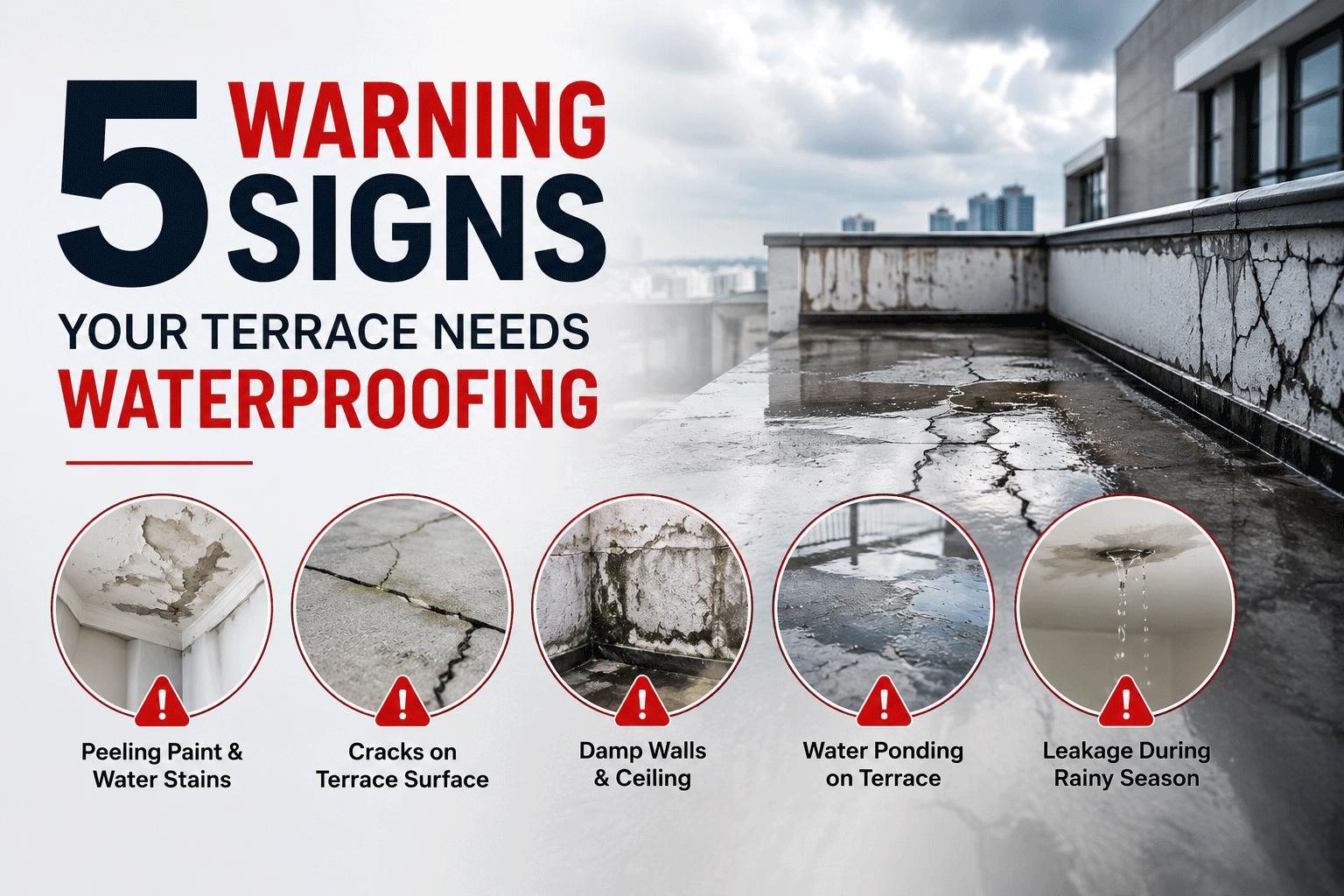
Terraces don't fail overnight. By the time water is visibly dripping from your ceiling, it has usually been entering the slab for months. The five signs below are how your terrace tells you it needs attention — well before the damage becomes structural. Catch even one of these early and a small waterproofing job stays small.
Why These Signs Matter More Than They Look
A terrace slab is concrete reinforced with steel. Water itself doesn't destroy concrete quickly — but water that reaches the steel reinforcement inside it causes the steel to rust, and rusting steel expands, cracking the surrounding concrete from the inside out. This is a slow, progressive process called spalling, and every one of the five signs below is an external clue that this process may already be underway.
The good news: every sign on this list is visible without any special equipment. You don't need a professional to notice them — you only need one to diagnose the exact cause and fix it properly.
The 5 Warning Signs Your Terrace Needs Waterproofing
Ceiling Stains or Damp Patches on the Floor Below
A yellowish-brown stain, a darkened patch, or plaster that looks "wet" on the ceiling of the top-floor room is the single most common first sign of terrace waterproofing failure. It means water has already travelled all the way through the slab above and is being absorbed into the plaster below.
Why it happens: the existing waterproofing membrane or coating has degraded or cracked somewhere on the terrace above, and water is finding a path straight down through the concrete.
Peeling, Bubbling or Flaking Paint on the Ceiling or Walls Below
Paint that bubbles, blisters or peels away in sheets — especially in a pattern that follows the terrace above rather than being scattered randomly — is moisture trapped beneath the paint film pushing it off the surface.
Why it happens: moisture that has entered the slab has nowhere to go and builds up pressure behind the paint layer until it fails. This is usually a later stage than a simple stain, meaning the water ingress has been ongoing for longer.
Cracks or a Hollow, Spongy Sound When Walking on the Terrace
Visible hairline cracks in the terrace surface, or a hollow "tok-tok" sound when you tap or walk over a specific patch, both indicate the surface layer has separated from the structural slab beneath it — a classic sign of long-term water damage under the surface.
Why it happens: water trapped between the screed layer and the waterproofing membrane (or the slab itself) breaks the bond between layers, creating a hollow pocket that sounds and feels different underfoot.
Water Pooling or Slow Drainage After Rain
If water sits on your terrace for more than a few hours after rain stops instead of draining away, the surface has lost its designed slope, drains are blocked, or both. Ponding water isn't just an inconvenience — it puts sustained hydrostatic pressure on any weak point in the waterproofing below.
Why it happens: debris-blocked drains, a settled or uneven screed, or a terrace that was never laid with adequate slope to begin with. Every hour water sits is extra time and pressure pushing it toward any crack or gap.
White Powdery Deposits (Efflorescence) or a Persistent Musty Smell
White, chalky, crystalline deposits on a wall or ceiling near the terrace are efflorescence — dissolved salts left behind as water migrates through masonry and evaporates at the surface. A musty or damp smell in the top-floor room, even without visible staining, is often the earliest detectable sign of all, since smell precedes visible symptoms.
Why it happens: water is actively moving through the concrete or masonry, carrying dissolved minerals to the surface as it evaporates. If you can smell dampness but can't see it yet, the water is still inside the structure — not gone.
Bonus Sign: Algae, Moss or Discolouration on the Terrace Surface
Green or black patches on the terrace surface itself indicate the area stays damp for extended periods — usually the same low spots identified in Sign 4. This is less urgent on its own but confirms a drainage or ponding problem that is very likely already causing hidden damage below.
Quick Self-Check You Can Do Today
- Walk the full terrace on a dry day and look for cracks, discolouration, or any area that looks or sounds different from the rest.
- Tap a few different spots with your foot or a stick — a hollow sound means a delaminated pocket underneath.
- Pour a mug of water on a suspect low spot and time how long it takes to drain — anything beyond a few minutes suggests a slope or drainage issue.
- Check the ceiling of the room directly below the terrace for stains, peeling paint, or a musty smell — do this even if the terrace itself looks fine.
- Look at boundary or parapet walls near the terrace for white efflorescence deposits climbing upward from the base.
What Happens If You Ignore These Signs
| Stage | What's Happening | Typical Fix |
|---|---|---|
| Early (Signs 1, 5) | Surface waterproofing has a weak point; water is just starting to enter | Localised crack repair and re-coating — lower cost, fast turnaround |
| Moderate (Signs 2, 3, 4) | Water has been entering for months; layers are delaminating | Full re-waterproofing of the affected area or entire terrace |
| Advanced (untreated for 2+ seasons) | Steel reinforcement corroding, concrete spalling | Structural repair plus waterproofing — several times the cost of early action |
The pattern is consistent: every sign on this list gets more expensive to fix the longer it's left, because the underlying cause — water inside the slab — doesn't pause between monsoons. It keeps working even in dry months.
Terrace Waterproofing Cost in Delhi NCR
| System | Cost (Per Sq Ft) |
|---|---|
| Polymer/cementitious coating | ₹35 – ₹55 |
| APP bituminous membrane | ₹60 – ₹90 |
| PU liquid waterproofing | ₹70 – ₹100 |
For the complete price breakdown by system and terrace type, see our full Terrace Waterproofing Cost Guide 2026, or visit our terrace waterproofing Delhi service page for how each system is applied.
What a Professional Inspection Actually Checks
Bhawani Technologies provides a free terrace inspection across Delhi NCR that goes beyond a visual check:
- Moisture-meter mapping to find exactly where water is entering, not just where symptoms appear
- Assessment of drainage slope and outlet condition
- Identification of whether the issue is surface-level or has reached the structural slab
- A written, itemised quotation — no guesswork, no bundled pricing
- A documented warranty on any repair or waterproofing work carried out
We also cover the causes behind these failures in more depth in our guide on why waterproofing fails in Delhi NCR, and what to inspect across your whole property in our Post-Monsoon Waterproofing Checklist 2026.
Frequently Asked Questions
-
What are the main warning signs that a terrace needs waterproofing?The five main warning signs are: ceiling stains or damp patches on the floor below the terrace, peeling or bubbling paint on the ceiling or walls, cracks or a hollow/spongy sound when walking on the terrace, water pooling or draining slowly after rain, and white powdery deposits (efflorescence) or a musty smell in rooms below.
-
Is a small ceiling stain really a sign my terrace needs waterproofing?Yes. A ceiling stain means water has already travelled through the terrace slab and is absorbing into the plaster below. It rarely stays small - it typically grows with each subsequent rain until it becomes active dripping. Treat even a small stain as an early warning, not a cosmetic issue.
-
Can I wait until next monsoon to fix these warning signs?Waiting is the most common mistake. Each of these warning signs indicates water is already inside the concrete slab, and every additional rain cycle drives it deeper, corroding the steel reinforcement. What is a straightforward waterproofing repair today often becomes a structural repair - at several times the cost - within two or three more monsoon seasons.
-
How do I check my terrace for these warning signs myself?Walk the terrace after it has been dry for a day and look for cracks, ponding water, or areas that sound hollow when tapped. Then check the ceiling of the top-floor room directly below for stains, peeling paint or a musty smell. If you notice any of these, book a professional inspection rather than guessing at the cause.
-
How much does terrace waterproofing cost in Delhi NCR?Terrace waterproofing in Delhi NCR typically costs ₹35-₹130 per sq ft depending on the system - polymer coating ₹35-₹55/sq ft, APP membrane ₹60-₹90/sq ft, and PU liquid waterproofing ₹70-₹100/sq ft. The exact cost depends on the extent of existing damage, confirmed only after a free inspection.
The Bottom Line
None of these five signs require a professional eye to notice — they just require you to look. What requires a professional is correctly diagnosing which one applies to your terrace and fixing the actual cause, not just the symptom you can see.
If you've spotted even one of these signs, get it inspected before the next rain. Contact Bhawani Technologies for a free terrace inspection across Delhi NCR — call +91-9555808158.