

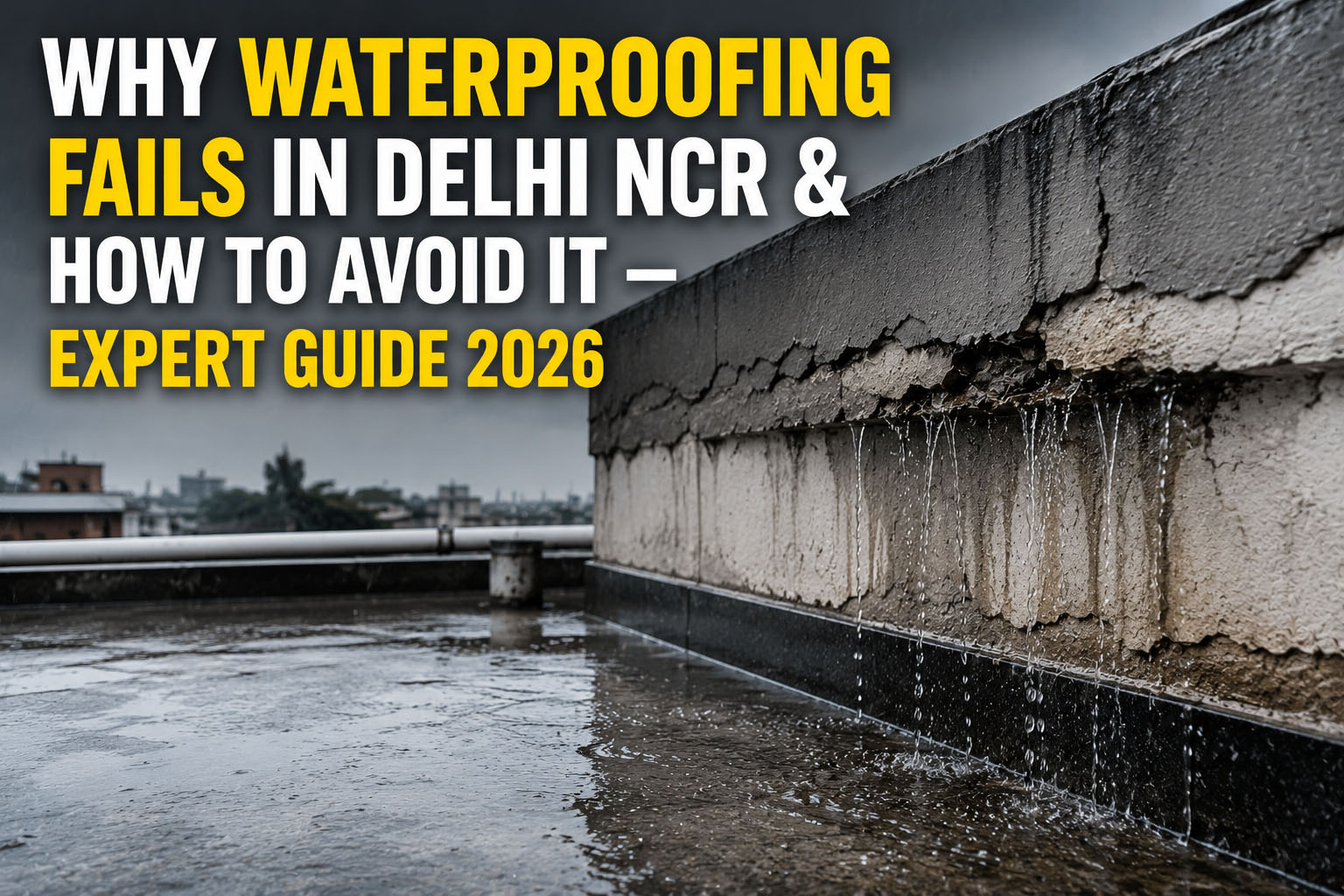
If your waterproofing has failed this monsoon: Do not apply another coat on top. The old failed system often needs to be removed first. Call Bhawani Technologies at +91-9555808158 for a free professional inspection and honest assessment.
The Most Frustrating Problem in Indian Construction: Waterproofing That Doesn't Work
Across Delhi NCR this July, tens of thousands of homeowners are discovering the same thing: the waterproofing they paid for — last year, two years ago, or even recently — has failed. Ceilings are staining. Terraces are dripping. Walls are damp. And the contractor who did the job is either unreachable or offering to "do it again" at another cost.
Waterproofing failure in India is so common it is almost expected. But it should not be. Properly selected and correctly applied waterproofing systems last 8 to 20 years under Delhi's extreme conditions. The failure is almost never the material — it is how it was specified, prepared and applied.
This guide explains, from a technical standpoint, exactly why waterproofing fails in Delhi NCR — and what you need to verify before your next waterproofing job to make sure it actually lasts.
Why Delhi NCR Is Uniquely Harsh on Waterproofing Systems
Before understanding why waterproofing fails, it helps to understand what Delhi's climate actually does to it. Delhi NCR subjects waterproofing materials to one of the most punishing combinations of conditions in the world:
- Extreme thermal cycling: Surface temperatures on a Delhi terrace reach 70–80°C in May–June (air temp 45°C + direct solar radiation). By January, the same surface is at 5–10°C. This 60–70°C annual swing causes repeated expansion and contraction that stresses every waterproofing material at its weakest points — joints, edges, penetrations and cracks.
- Concentrated monsoon intensity: Delhi receives 600–700mm of rain, but roughly 80% of it falls in just 8–10 weeks (July–August). This concentrated hydrostatic loading on flat terraces and slabs is far more punishing than the same rainfall distributed across the year.
- UV degradation: Delhi's flat terrace surfaces receive intense UV exposure for 9+ months of the year. Most polymer and bitumen-based systems degrade from UV unless properly protected. An unprotected PU or acrylic system left exposed will become brittle and crack in 3–5 years.
- Construction quality variability: Delhi's rapid construction over the past 30 years produced enormous variability in concrete quality, cover depth and structural detailing. Waterproofing applied over poor concrete has an inherently shorter life than the same material applied over well-constructed substrates.
The implication: A waterproofing system that performs adequately in Mumbai, Bangalore or Chennai will not necessarily perform equally in Delhi. System selection must account for Delhi's specific thermal and UV conditions — not just waterproofing ability.
The 9 Real Reasons Waterproofing Fails in Delhi NCR
After inspecting hundreds of failed waterproofing jobs across Delhi, Noida, Gurgaon and Ghaziabad, these are the nine most common causes — ranked by frequency:
Inadequate or Skipped Surface Preparation
This is the single biggest cause of waterproofing failure — responsible for an estimated 40–50% of failures. Surface preparation should take 30–50% of the total project time. It includes: removal of all existing failed coatings, laitance and loose concrete; grinding or shot-blasting the substrate to achieve proper adhesion profile; crack cutting (V-cut or U-cut) of all visible cracks; cleaning with air pressure to remove dust and debris; and application of appropriate primer. Contractors who cut preparation time to save cost are guaranteeing early failure. When a contractor arrives at your home and begins applying the waterproofing material within an hour of starting work — that is a red flag.
Wrong System Chosen for the Application
Not all waterproofing systems work in all conditions. APP bituminous membranes are excellent for flat terraces but unsuitable for vertical surfaces or surfaces that cannot be torched. PU liquid waterproofing is ideal for complex geometries but degrades rapidly without UV protection (a screed or tile overlay). Crystalline waterproofing works from within concrete but cannot bridge active cracks without reinforcement. Acrylic polymer coatings are suitable for mild dampness but inadequate for active water pressure. When a contractor applies whatever system they stock — regardless of the substrate, water pressure or surface geometry — failure is predictable.
Parapet Wall and Junction Left Untreated
The junction between the flat terrace slab and the parapet wall is the most mechanically stressed point in any roof system. Differential thermal movement between the wall and the slab creates a shear force at this joint every day of the year. Any waterproofing that does not address this junction with a reinforced treatment — typically a coved fillet with reinforcing fabric — will fail here first, usually within 1–2 monsoon cycles. Similarly, pipe penetrations, drain collars, AC unit bases and any other protrusion through the slab must receive reinforced junction treatment. This step is routinely skipped by low-cost contractors.
Untrained Applicators
Waterproofing is a skilled trade. APP membrane torch application requires trained technicians who understand flame temperature, overlap width, corner detailing and heat-welding joints. PU liquid application requires precise DFT (dry film thickness) measurement per coat, correct mixing ratios and appropriate recoat intervals. Crystalline application requires correct dilution and application technique for the compound to penetrate adequately. General construction labour — even skilled masons — are not trained waterproofing applicators. A Dr. Fixit or Sika recognised applicator designation specifically means the applicator team has been trained and certified by the manufacturer. Without this, material performance is unpredictable regardless of brand quality.
Cracks Not Injected — Just Painted Over
Surface coating over cracks — even with a "waterproof" material — does not seal the crack. Water under pressure finds the path of least resistance, and a crack filled with paint has no resistance. Cracks must be cut open (widened to a V or U profile), cleaned, and either injected with polyurethane or epoxy under pressure, or filled with flexible polymer sealant before the surface coating is applied. This step requires equipment (an injection pump), material (PU injection cartridges or two-component epoxy) and skill. It is also time-consuming. Low-cost contractors skip it and coat directly over cracks. The coating bridges the crack temporarily and fails at the next thermal cycle.
Inadequate Material Thickness / Coverage
Every waterproofing system has a specified dry film thickness (DFT) or coverage rate — the minimum application that the manufacturer's performance data is based on. A PU liquid system specified at 1.5mm DFT applied at 0.8mm will perform proportionally worse. An APP membrane specified at 4mm torch-applied can be thinned during torching if the technician moves too fast. Coverage rate manipulation is how contractors reduce material cost invisibly — you cannot see the thickness difference by eye. Always ask for the material's TDS (Technical Data Sheet) and verify the specified coverage rate matches what appears in your quotation.
No UV Protection on Exposed Systems
PU liquid waterproofing, acrylic coatings and some modified bitumen systems require UV protection if left exposed on a Delhi terrace. Without it, Delhi's 9-month intense UV season degrades the polymer chains in the material, making it brittle and prone to cracking within 3–5 years. Protection options include: a screed overlay, ceramic tile overlay, aluminium foil-faced membrane, or UV-stable topcoat. Many contractors apply PU waterproofing without UV protection, collect their fee, and know that a failure call in 3 years is unlikely to be traced back to them.
Application in Wrong Weather Conditions
Most waterproofing systems have strict application temperature and humidity requirements. PU liquid systems cannot be applied below 10°C or above 40°C (surface temp), which excludes much of Delhi's calendar if contractors are not careful. Polymer cementitious systems require a damp — not wet — substrate, and must be protected from rain for 24–48 hours after application. APP membrane torching in Delhi's summer months (May–June) on a 70°C surface can cause the membrane to blister. Contractors under pressure to complete jobs quickly ignore weather windows and application conditions — the material appears applied but does not perform.
Applying New Waterproofing Over Failed Old Waterproofing
One of the most common and expensive mistakes: applying a new waterproofing coat directly over an old, failed system without removing the failed layer. The new material bonds to the old failed coating — not to the substrate. When the old coating delaminates further (which it will), it takes the new coating with it. The result is two layers of failed waterproofing for twice the cost. The correct process is to mechanically remove the failed system, inspect and repair the underlying substrate, and then apply the new system to bare, sound concrete. This takes more time and cost upfront — and saves complete failure within 1–2 years.
How to Spot a Bad Waterproofing Contractor Before You Hire Them
Most waterproofing failures are predictable from the contractor selection stage. These are the warning signs to watch for before you sign anything:
- Quotes a price on the phone or WhatsApp without visiting the site
- Cannot name the specific product and brand they will use
- Quotation is a single lump sum with no breakdown of scope, system or sq ft
- Cannot provide a Technical Data Sheet (TDS) for the material
- Offers to do the job immediately with no inspection or preparation phase
- Significantly cheaper than all other quotes (price reflects skipped steps)
- Cannot explain how they will treat the parapet-slab junction or cracks
- Offers only a verbal warranty — not a written document
- Cannot provide verifiable references or a project portfolio
Conversely, here is what a reliable waterproofing contractor in Delhi NCR does:
- Conducts a free on-site inspection with moisture meter before quoting
- Provides a written, itemised quotation — system name, brand, coats, sq ft, warranty
- Can provide the TDS for the specified material on request
- Spends adequate time on surface preparation before application begins
- Treats all junctions, penetrations and drains with reinforced detail
- Issues a written warranty document on project completion
- Is a recognised/certified applicator for the brand they use
Waterproofing System Lifespan in Delhi NCR — What to Realistically Expect
When properly selected and correctly applied, these are the realistic lifespans of common waterproofing systems under Delhi NCR's conditions:
| System | Best Application | Lifespan (Correct Application) | Lifespan (Poor Application) |
|---|---|---|---|
| APP Bituminous Membrane | Flat terraces, podium slabs | 10 – 15 years | 1 – 3 years |
| PU Liquid Waterproofing | Complex surfaces, bathrooms, roofs | 8 – 12 years (with UV protection) | 2 – 4 years |
| Crystalline Waterproofing | Concrete basements, tanks, new slabs | 15 – 25 years (becomes part of concrete) | 3 – 6 years (if not deep enough) |
| Polymer Cementitious Coating | Bathrooms, water tanks, mild dampness | 5 – 8 years | 1 – 2 years |
| Acrylic / Elastomeric Coating | Exterior walls, mild roof protection | 4 – 7 years (with UV-stable topcoat) | 1 – 2 years |
| Epoxy Waterproofing | Industrial floors, water-retaining structures | 8 – 12 years | 2 – 3 years |
Real cost comparison: Cheap waterproofing at ₹20–30/sq ft that lasts 2 years costs ₹10–15/sq ft/year. Proper waterproofing at ₹60–90/sq ft that lasts 12 years costs ₹5–7.5/sq ft/year — and causes zero structural damage in the interim. The maths favours doing it right the first time.
What to Do If Your Waterproofing Has Already Failed
If your waterproofing has failed — whether recently done or older — follow this process for a proper remediation:
- Get a professional inspection first. Do not simply apply another product. A qualified inspector using moisture meters will identify the failure mode — surface delamination, crack re-opening, junction failure or systemic preparation failure — and recommend the correct remediation approach for your specific situation.
- Remove the failed system. In most cases the failed waterproofing material must be mechanically removed before any new system is applied. Applying over a failed system guarantees the same or faster failure. This step is non-negotiable for a lasting repair.
- Inspect and repair the substrate. Once the failed system is removed, inspect the underlying concrete. Repair spalls, hollow areas and cracks — crack injection for active or structural cracks, polymer mortar for surface spalls. The substrate condition is what determines whether the new waterproofing will bond and last.
- Choose the correct system for your situation. Based on the failure mode diagnosis, surface type and water pressure conditions, select the appropriate waterproofing system — not whatever is cheapest or whatever the contractor stocks.
- Ensure junction and penetration treatment. Every parapet junction, pipe penetration, drain collar, AC unit base and construction joint must receive reinforced detail treatment. These are the highest-risk failure points.
- Get a written warranty on the new work. A written warranty is a contractor's commitment to the quality of their work. If they cannot offer one, their confidence in their own application should be questioned.
For service-specific guidance on remediation, read our detailed pages on terrace waterproofing in Delhi, roof leakage repair in Delhi, basement waterproofing in Delhi and bathroom waterproofing in Delhi.
The True Cost of Waterproofing Failure — Beyond the Repair Bill
Most homeowners think about waterproofing failure in terms of the repair cost. The actual cost is significantly higher:
| Consequence of Waterproofing Failure | Estimated Additional Cost |
|---|---|
| Re-doing failed waterproofing (removal + new application) | 1.5x – 2x original cost |
| Interior plaster repair and repainting after water damage | ₹15,000 – ₹60,000 per room |
| Wood flooring or furniture damage from water ingress | ₹20,000 – ₹2,00,000+ |
| Rebar corrosion and spalling concrete repair (structural) | ₹500 – ₹2,000 per sq ft |
| Electrical damage from water near fittings | ₹5,000 – ₹50,000 |
| Property value reduction from visible water damage | Significant — especially for resale |
Every monsoon that passes through a failed waterproofing system adds cumulative damage. A ₹1,500/sq ft waterproofing failure that is ignored for 3 monsoon seasons frequently results in ₹3,000–₹5,000/sq ft in structural repair costs — in addition to re-doing the waterproofing.
How Bhawani Technologies Ensures Waterproofing That Actually Lasts
We have built our business on waterproofing that does not fail. This is not a marketing claim — it is a business model. Every project we complete carries a written service warranty. If our waterproofing fails within the warranty period, we come back and fix it at our cost. That warranty is only commercially viable if our work is done correctly in the first place.
Here is specifically what we do differently on every project:
- Free on-site inspection using professional moisture meters — entry points mapped, not guessed
- Written itemised quotation specifying exact system, brand name, coat count and sq ft coverage
- Mechanical removal of all existing failed waterproofing before any new application
- Polyurethane or epoxy injection grouting of all cracks — not painted over
- Reinforced treatment of all parapet junctions, drain collars and penetrations
- Application by trained, certified applicators — not general masons
- Thickness verification during application using wet film thickness gauge
- UV protection specified and applied wherever the system requires it
- Written warranty document issued at project completion
We are a Dr. Fixit recognised applicator — certified and trained to apply Dr. Fixit waterproofing systems per manufacturer specification. We also work with Sika, Fosroc and other certified brand systems depending on the project requirement. Technical Data Sheets are available on request for any system we specify.
We provide waterproofing services across Delhi, Noida, Gurgaon, Ghaziabad, Greater Noida and Faridabad — and large-scale projects across India. For more information on what we cover, visit our waterproofing services page or about page.
Frequently Asked Questions
-
Why did my waterproofing fail after just one monsoon?The most common reasons are: (1) Inadequate surface preparation — the surface was not properly cleaned, primed or cracks were not injected before coating; (2) Wrong system for the application — the material was not suited to the water pressure or surface type; (3) Untrained applicators — applied incorrectly, too thin or with missed coverage at junctions; (4) Parapet-slab junction untreated — the highest-failure-risk point left without reinforced detail. A professional inspection will identify which of these caused your failure.
-
How can I tell if a waterproofing contractor is doing the job correctly?Key signs of a proper job: the contractor inspects with a moisture meter before quoting; surface preparation takes significant time before any material is applied; cracks are cut open and injected, not painted over; the parapet junction receives a reinforced fabric + cove fillet treatment; a written itemised quotation is provided specifying brand, product, coats and sq ft; and a written warranty document is issued at completion. If preparation starts immediately on day one with no removal or crack work — that is a warning sign.
-
My terrace was waterproofed 2 years ago and is leaking again — what should I do?Do not apply another coat on top of the failed system. Get a professional inspection first to identify the failure mode. In most cases the failed waterproofing must be mechanically removed before any new system is applied. Applying over a failed system guarantees the same failure within a similar timeframe. Call Bhawani Technologies at +91-9555808158 for a free inspection and honest assessment.
-
Is cheap waterproofing ever as good as expensive waterproofing?No — not in Delhi's climate. The combination of 70-80°C summer surface temperatures, 5°C winter temperatures, intense UV and concentrated monsoon rainfall is one of the most demanding environments for waterproofing anywhere. Budget materials and untrained application fail within 1–3 years under these conditions. The real comparison is: cheap waterproofing every 2 years (with structural damage accumulating) vs proper waterproofing every 10–12 years. The long-term maths strongly favour quality.
-
What is the lifespan of proper waterproofing in Delhi NCR?With correct system selection and proper application: APP bituminous membrane lasts 10–15 years; PU liquid waterproofing lasts 8–12 years with UV protection; crystalline waterproofing lasts 15–25 years; polymer cementitious coating lasts 5–8 years. With poor surface preparation or wrong system choice, all of these can fail within 1–3 years. Lifespan is determined more by how the job is done than by the brand of material used.
-
How do I find a reliable waterproofing contractor in Delhi NCR?Look for: Dr. Fixit or Sika recognised applicator status; a physical office and verifiable address; a portfolio of completed projects with references; a written itemised quotation specifying the exact product, system, coats and sq ft; and a written warranty document issued on completion. Avoid any contractor who quotes on the phone without visiting, cannot name the product they will use, or cannot provide a written warranty.
The Bottom Line: Most Waterproofing Failures Are Preventable
The waterproofing industry in India has a trust problem — not a technology problem. The materials available today are excellent. The systems that Dr. Fixit, Sika, Fosroc and others have developed will perform reliably for 10–20 years when applied correctly. The failures that homeowners across Delhi NCR are dealing with this monsoon are almost entirely the result of skipped preparation, wrong system selection, untrained application, and missing junction treatment.
Protecting yourself comes down to one principle: choose a contractor who can and will back their work in writing. A written warranty is a contractor's financial commitment to the quality of their work — and it is only commercially sustainable if the work is actually done right.
Bhawani Technologies has been providing warranty-backed waterproofing across Delhi NCR since 2013. We offer a free on-site inspection — call us at +91-9555808158 or visit our contact page. We cover terrace waterproofing, roof leakage repair, basement waterproofing, bathroom waterproofing and all related waterproofing services across Delhi NCR.
If your property took on water damage this monsoon, see our Post-Monsoon Waterproofing Checklist 2026 for exactly what to inspect and repair before winter, or our 5 warning signs your terrace needs waterproofing for a quick self-check.